
Views: 0 Author: Site Editor Publish Time: 2025-09-08 Origin: Site


A slitter rewinder helps you cut big rolls into smaller ones. You put a roll of paper, film, or foil on the machine. The slitter unwinds the material and cuts it into strips. Then, it rolls each strip onto new cores. This makes work faster and cuts down on waste. It also helps save money.
| Function | Description |
|---|---|
| Unrolling | The machine takes the big roll and unrolls it. |
| Slitting | The machine cuts the unrolled material into strips. |
| Rewinding | The strips are rolled onto new cores for easy use. |
A slitter rewinder cuts big rolls into smaller ones. This makes work quicker and helps stop waste.
Important things in a slitter rewinder are easy control panels, good tension control, and safety sensors. These help the machine work well and keep people safe.
You must check belts and oil parts often. This keeps the machine working well and stops accidents.
Automation in slitter rewinders makes work faster. It also helps rolls come out the same every time.
Picking the right slitter rewinder depends on the material, roll width, and speed you want. So, it is smart to do research and ask experts for help.
A slitter rewinder machine helps you turn big rolls into smaller ones. It works best for companies that use paper, film, or foil. The machine takes a large roll and cuts it into thin strips. Each strip is rolled onto a new core. This makes the rolls easier to use and move.
A slitter rewinder does two jobs: slitting and rewinding. You put the main roll into the machine. Unwind stands hold the roll steady and keep it moving. Sharp blades cut the material into the sizes you want. Rewind units roll each strip onto its own core. You can use control panels to set speed, tension, and width. This helps you get the results you need.
Juyouzn’s machines have advanced tension control and automation. These features help you get clean cuts and good rolls. Their machines also have safety sensors and emergency stops. These keep you and your team safe while working.
Tip: When picking a slitter rewinder, look for features like easy control panels and tension control. These make your work faster and safer.
| Component | Description |
|---|---|
| Unwind Stands | Holds the main roll and keeps the material feeding smoothly. |
| Tension Control System | Keeps the tension steady for clean cuts and no stretching. |
| Slitting Units | Has sharp blades that cut the material into thin strips. |
| Rewind Units | Rolls each strip onto a new core to make finished rolls. |
| Control Panels | Lets you set how the machine works and check its data. |
| Safety Features | Has emergency stops and sensors to keep workers safe. |
All modern slitter rewinder machines have these parts. Juyouzn’s machines use smart tension control and automation. This helps you get better results with less work.
A slitter rewinder machine gives you many helpful features. You can upgrade your machine for better speed and output. Automation helps you do more work with less effort. Energy-saving designs help you spend less on power and waste.
| Function/Feature | Description |
|---|---|
| System Performance Upgrades | Makes your machine work faster and better. |
| Automation Integration | Adds automatic steps to make work easier. |
| Increase Energy Efficiency | Uses less energy to save money. |
| Adaptation for New Materials | Lets you work with different types of materials. |
| Cost-Effective Solutions | Lets you upgrade without buying a whole new machine. |
| Increased Efficiency | Helps you do more work with less waste. |
| Enhanced Capabilities | Adds new features like better tension control. |
| Sustainability Focus | Helps you save energy and cut down on waste. |
You get more than just cutting and rolling. With a paper slitter and rewinder, you can handle many materials, work faster, and save money. Juyouzn’s machines use automation and AI. This helps you find problems quickly and work better.
You may wonder how a slitter rewinder is different from other machines. Here is what you should know:
A slitter rewinder both cuts and rolls up the material. You use it when you want neat rolls ready for the next step.
A slitting machine only cuts the material into strips. It does not roll the strips onto new cores.
The word slitter can mean any machine that cuts material. Sometimes it means a simple cutter with no rolling part.
Note: Frances Meisel got a patent for the slitter rewinder in 1980. You might also hear it called a slitter, rewind slitter, or roll slitter.
If you use a paper slitter and rewinder, you can cut and roll in one step. This saves time and helps you avoid mistakes. Juyouzn’s machines are fast and easy to adjust. You can switch between materials and roll sizes quickly.
Safety is important when using a slitter rewinder machine. Safety sensors can spot danger and stop the machine right away. Training helps you learn how to use the machine safely. Regular checks keep the machine working well and help prevent accidents.
| Safety Consideration | Description |
|---|---|
| Safety Sensors | Find dangers and stop the machine if needed. |
| Operator Training | Teaches you how to use the machine safely. |
| Maintenance and Inspection | Regular checks make sure safety parts work. |
| Fire Prevention | Use fire systems and keep the area aired out. |
| Noise Reduction | Use soundproofing and ear protection for loud machines. |
| Ergonomics | Make the machine comfortable to use and prevent injuries. |
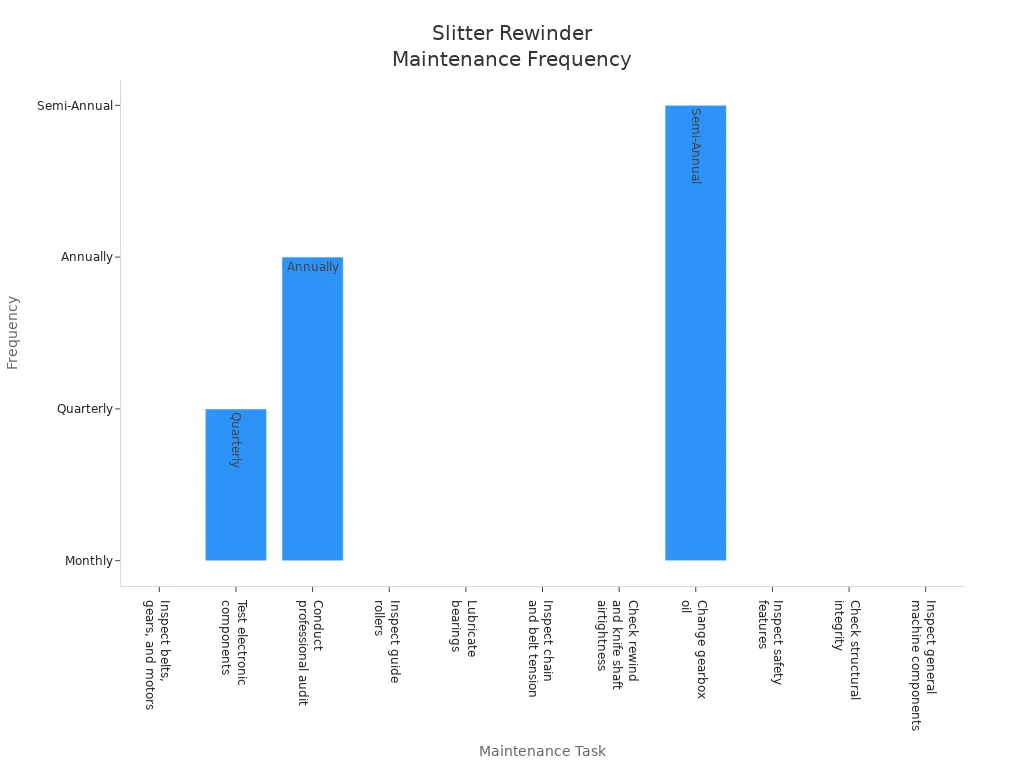
Check belts, gears, motors, and safety parts every month. Oil the bearings and check the tension often. Juyouzn says to test electronics every three months and get a pro to check the machine once a year.
| Maintenance Task | Frequency |
|---|---|
| Inspect belts, gears, and motors | Monthly |
| Test electronic components | Quarterly |
| Conduct professional audit | Annually |
| Inspect guide rollers | Monthly |
| Lubricate bearings | Monthly |
| Inspect chain and belt tension | Monthly |
| Check rewind and knife shaft airtightness | Monthly |
| Change gearbox oil | Semi-Annual |
| Inspect safety features | Monthly |
| Check structural integrity | Monthly |
| Inspect general machine components | Monthly |
New technology comes out for slitter rewinder machines every year. Automation helps you work faster and do less by hand. AI helps you spot problems and work better. Energy-saving designs help you spend less and help the planet.
Automation makes the machine work faster and with less help.
AI helps you find problems and work more efficiently.
Energy-saving designs help you waste less and save money.
Better precision gives you cleaner cuts and better rolls.
Automated systems help you work longer without stopping.
Better handling and tension control give you steady results.
If you pick a paper slitter and rewinder from Juyouzn, you get these new features. Their machines are fast, easy to set up, and have good tension control. You can work with many materials, change roll sizes, and keep quality high with less work.
Tip: Keep your machine in good shape and train your team. Juyouzn’s new models make this easier with built-in safety and check-up tools.
The slitting machine process turns big rolls into smaller ones you can use. You follow steps to make sure cuts are clean and rolls are good. Each part of the process helps make things work well and keeps waste low.
First, you put the parent roll on the slitter rewinder. The unwinding part feeds the material into the machine. Keeping tension steady is very important. If tension is right, the material does not stretch or tear. Most new machines use sensors and rollers to control tension. Some machines use magnetic powder clutches to control force.
Operators must follow safety rules during unwinding. Never lean on the machine when it is running. Always secure the roll so it does not fall. When unloading, brake the arm pulley to stop accidents. Keep your hands away from moving parts. Do not leave tools inside the machine.
| Requirement | Description |
|---|---|
| Operator Qualification | Operators need training and must follow rules. |
| Safety Precautions | Do not lean on the machine while it works. |
| Loading Safety | Secure the roll so it does not drop. |
| Unloading Safety | Brake the arm pulley when unloading. |
| Mechanism Safety | Keep hands away when opening or closing doors. |
| Tool Safety | Never put tools inside the machine when it runs. |
Good tension control is needed for materials like aluminum foil. Manual and automatic systems help keep tension steady at all speeds. This is true even when speeding up or stopping fast. This step helps the material move smoothly to the next part.
Tip: Keeping tension steady during unwinding helps you avoid problems and keeps the process smooth.
Next, the material goes into the slitting section. Sharp blades cut it into thinner strips. The slitting machine uses different ways to cut, depending on the material. Razor slitting is best for thin, bendy things like plastic films and light paper. Shear slitting gives smooth, neat cuts for thick things like heavy paper, foils, and laminated films. Crush slitting works for tough materials but leaves rough edges.
| Slitting Technique | Advantages | Disadvantages | Best Suited For |
|---|---|---|---|
| Razor Slitting | Quick setup, good for thin items | Blades wear out fast, may tear | Thin, bendy materials (plastic films, paper) |
| Shear Slitting | Smooth, clean edges | Takes longer, needs care | Thick materials (heavy paper, foils, films) |
| Crush Slitting | Works for tough materials | Edges are rough, less exact | Hard materials (cardboard, nonwovens) |
You need to check knife alignment and keep blades sharp. Bad edges happen if blades are dull or not lined up. Checking often and setting up right helps you get clean cuts. Using the right knife and oil helps blades last longer and not break.
Problems during slitting include tension issues, slow setup, and stops. You can fix tension problems with entry and exit loops. Automated setup helps you start faster. Rapid stop systems help you recover quickly after emergencies. Training and automation help when there are not enough workers.
Tension problems cause defects. Entry and exit loops help fix this.
Slow setup wastes time. Automated setup makes things faster.
Emergency stops cause delays. Rapid stop systems help you get back to work.
Not enough workers is hard. Training and automation help fill jobs.
Always check strips for good edges and even size. Sensors and live monitoring help you find problems early. This keeps quality high and waste low.
After slitting, you go to the rewinding part. The machine rolls each strip onto new cores. You must wind tightly to stop defects. Even winding keeps rolls tight and stops them from coming loose. You also need to control static to protect the material and keep the area safe.
| Quality Parameter | Description |
|---|---|
| Cutting accuracy/finish | Clean cuts for good product quality |
| Winding accuracy/finish | Even winding stops defects |
| Reel tightness | Tight rolls do not come apart |
| Residual static levels | Controls static for safety and protection |
Check each roll for tightness and finish. Keep checking and controlling quality to catch problems early. Many machines use sensors to watch winding and cutting. This helps lower waste and makes things work better.
After rewinding, you pack the strips for shipping. Recycling helps you manage waste. Energy-saving machines and noise control make your work better for the planet.
Note: Regular checks, blade changes, and tension control keep your machine working well. This helps you avoid problems and keep product quality high.
Unwind the big roll of material.
Feed the material into the cutting part.
Cut the material into thin strips with blades.
Roll the strips onto new cores.
Check and control quality at every step.
Pack the finished rolls for shipping.
You can use a paper slitting machine for many materials. The slitter helps you get neat cuts and tight rolls. If you follow each step, you work better and waste less. This saves money and helps the environment.
Many materials can be used with a slitting machine. The most common ones are plastic films, paper, foils, laminates, and labels. Each material is used for different things and has a share of the market. Plastic films are often used for packaging, farming, and medical items. These films make up about 45% of all materials used. Paper and board are used for packaging and printing. They have 25% of the market. Foils, mostly aluminum, are used to keep food and medicine safe. They cover 10% of the market. Laminates are strong and used for packaging and electronics. They make up 12% of the market. Labels are used to help people know what products are. They have 8% of the market.
Plastic Films: 45% market share, used in packaging, agriculture, medical
Paper & Board: 25% market share, used for packaging, printing
Foils: 10% market share, mainly aluminum, used in food, pharma
Laminates: 12% market share, used in packaging, electronics
Labels: 8% market share, used for product identification
A slitter changes big rolls into smaller ones you can use. The paper slitting machine is good for paper, board, and labels. You pick the right slitting machine for the material you want to cut.
There are different ways to slit materials. You choose the method based on what you are cutting and how you want it to look. Each way has good and bad points. The table below shows the main slitting methods and what is good or bad about them:
| Slitting Method | Advantages | Disadvantages |
|---|---|---|
| Razor Slitting | Low cost, High-speed operation, Minimal dust production | Limited to thin materials, Frequent blade replacements |
| Shear Slitting | High precision, Versatile, Long blade lifespan | Higher initial investment, Requires skilled operation |
| Score Slitting | Simple and cost-effective, Ideal for pressure-sensitive materials, Fast processing speed | Lower precision, Not suitable for hard materials |
| Hot Knife Slitting | Seals edges during cutting, Ideal for synthetic materials, Reduces dust and debris | Slower than other methods, Not suitable for heat-sensitive materials |
| Ultrasonic Slitting | Precision cutting, Minimal material deformation, Eco-friendly | High equipment cost, Limited material compatibility |
| Laser Slitting | Unmatched precision, No physical contact, Automated process | High cost, Slower than mechanical methods |
| Water Jet Slitting | No heat generation, Precision cutting, Minimal material waste | High water consumption, Limited to soft materials |
You pick a slitting method based on what you need to cut. Razor slitting is best for thin films. Shear slitting gives neat cuts for paper and mixed materials. Score slitting works well for sticky materials.
You must pick the right blade for your slitting machine. The blade you use changes how good your finished product is. Shear slitting blades help you make neat cuts in many jobs. Razor slitting blades are cheap and work well for plastics and films. Crush cut blades are best for thick things like paperboard and laminates. They help you get cleaner cuts.
Shear Slitting Blades: Used for precise cuts in paper, composites
Razor Slitting Blades: Economical for plastics, films, tapes
Crush Cut Blades: Suitable for thick materials, cleaner cuts
The blade you pick changes how well you cut and how good your product is. Shear blades make less heat, so your material stays safe. Crush cut blades make less dust, so your rolls are cleaner.
Tip: Always use the right blade for your material and slitting method to get the best results.
When you pick a slitting machine, think about what you need. You should look at your material, how wide your rolls are, how fast you want to work, and if you want automation. The right paper slitter and rewinder can help you save money and get better results.
First, check what kind of material you want to cut. Each paper slitter and rewinder works best with certain materials. Make sure the machine can handle your material, like paper, film, foil, or laminates. Some machines have special ways to cut tough or delicate materials. You also need to think about safety and how easy the machine is to use. Juyouzn has machines with good tension control and automation. These features help you work with many types of materials.
Works with different materials
Has special cutting parts
Fast and productive
Uses new technology
Follows safety rules
Easy for workers to use
Simple to fix and keep working
Good price and saves money
Research and ask for advice
Tip: Always do your homework and talk to experts before buying a paper slitter and rewinder. This helps you pick the best machine and avoid problems.
How wide your roll is matters when picking a slitter rewinder. Machines can only handle rolls up to a certain width. For example, duplex slitter/rewinders can cut rolls up to 2200 mm wide. If your roll is wider, you need special rewind stations. You also need to choose the right way to wind the rolls, like center, center/surface, or surface winding. This depends on your material and how thick it is.
| Feature | Impact on Roll Width | Notes |
|---|---|---|
| Setup Changes | High | Changing widths often can slow down your work. |
| Automation Level | Varies | More automation can make setup faster for different widths. |
| Lay-on Roller Systems | Essential | You need different rollers for different roll widths. |
Duplex slitter/rewinders can handle up to 2200 mm wide rolls.
Wider rolls need their own rewind stations.
You can pick from different winding styles for any roll width.
Note: The kind and thickness of your material will help you decide which winding style you need.
Speed and automation help your paper slitter and rewinder work better. Fast machines let you finish jobs quickly. Automation helps you load and unload rolls faster and set up knives easily. Juyouzn’s machines use shaftless pickup unwinds and cantilevered rewinds for quick changes. Automatic machines can also check for problems by themselves. This means less time stopped and more time working.
Use shaftless pickup unwinds and cantilevered rewinds for fast loading.
Easy setups for short jobs, like moving knives and placing cores with lasers.
Automate things like cutting off rolls and moving finished rolls for medium jobs.
Automatic slitting rewinding machines can run from 50 m/min to over 1000 m/min. For careful jobs, like Kraft Paper, speeds are 50 to 300 m/min. For big jobs, speeds can go over 1000 m/min.
Tip: Faster speed and more automation mean less waste, fewer workers, and more money.
When you pick a slitter, think about power, speed, space, workers, warranty, safety, and automation. Juyouzn’s paper slitter and rewinder models have many choices for different materials, roll widths, and speeds. Always match what you need with what the machine can do to get the best results.
Slitter rewinder machines are used in many industries. They help cut big rolls into smaller, easier-to-use sizes. You use a slitter when you need careful cutting and rolling. Many businesses need this kind of machine for their work.
| Industry | Typical Applications |
|---|---|
| Paper and Pulp | Cutting big paper rolls into smaller ones for printing, packaging, and making stationery. |
| Packaging | Cutting plastic films and aluminum foil for food and other packaging. |
| Textile | Cutting fabric and non-woven materials into rolls for making clothes. |
| Label and Tape | Making rolls of sticky labels and tapes that meet exact needs. |
Slitting is also used in:
Packaging: Cutting big rolls of packaging into smaller pieces.
Printing: Getting paper and film ready for printing jobs.
Manufacturing: Cutting steel and aluminum to the right size for making things.
Textiles: Cutting fabric and non-woven materials for different uses.
A slitter rewinder machine helps each industry do its job better. You get rolls that fit your machines, so work is faster and easier.
Using a slitter rewinder makes your work better. Automation helps you cut and roll with less effort. You get the same good results every time. This means your products are better and you waste less. You save both money and time.
Here is how slitting machines help you:
Automated slitter rewinders use new technology to cut and roll with little help from people.
Automation gives you the same results every time, so your products are better and you waste less.
Slitting machines make your work faster and more exact, which means less waste and less stopping.
You can change the machine to fit your needs, so it works for many jobs.
Careful cutting and rolling make sure your products are always good, so there are fewer mistakes and complaints.
You can see the benefits in the table below:
| Achievement | Description |
|---|---|
| Material Cost Savings | Saved a lot of money by wasting less material. |
| Enhanced Process Reliability | The process got 25% better, saving even more money. |
| Reduced Waste | Automation means fewer mistakes, so you waste less and save money. |
| Increased Production Efficiency | Working automatically makes things more exact and faster. |
| Company Example | Metlon Corporation wasted less than 5% of material, saving a lot of money. |
More people want slitter rewinder machines every year. There is more need for packaging and better machines in factories. The market is growing from USD 1.07 billion in 2021 to USD 1.50 billion by 2029, with a yearly growth rate of 4.30%.
Tip: If you want to make your work better, waste less, and save money, try a slitter rewinder machine. You will see better results and your business will run smoother.
A slitter rewinder changes big rolls into smaller rolls you can use. This machine works with things like film, foil, and laminates. It does the job quickly and cuts very neatly. The process has three main steps: unwinding, slitting, and rewinding.
| Step | Description |
|---|---|
| Unwinding | You put the big roll on the machine to start. |
| Slitting | Rotary knives slice the material into thin strips. |
| Rewinding | The strips get rolled onto new cores for easy moving and shipping. |
There are lots of good things about using this machine:
You save time and money
Cuts are always neat and even
You waste less and help the environment
Before you pick a slitter, think about what material you have, how wide your rolls are, and if you want the machine to work by itself.
A slitter rewinder is a machine that cuts big rolls into smaller ones. You use it for things like paper, film, foil, and other flexible stuff. It helps you get neat rolls that are easy to use for your work.
Think about what material you want to cut. Check how wide your rolls are and how fast you need to work. Look for machines with automation and easy controls. Ask experts for help. Juyouzn has machines that control tension well and are simple to set up.
You can use a slitter rewinder for paper, plastic film, aluminum foil, laminates, and labels. Each machine works best with certain materials. Always read the details before you buy one.
A slitter rewinder helps you work faster and waste less. Automation lets you cut and roll with less effort. You save money and get better results for your business.
Look for safety sensors, emergency stops, and controls that are easy to use. Training and regular checks help keep you safe. Juyouzn machines have advanced safety systems for your team.