
Views: 0 Author: Site Editor Publish Time: 2025-08-28 Origin: Site


A slitter rewinder machine cuts big rolls into smaller rolls. This machine works with paper, plastic film, foil, and fabric. The slitter rewinder uses sharp blades to cut these materials. It then rolls them up again into tidy rolls. Companies use the slitter to work faster and waste less. The world market for slitting machines was $417.4 million in 2019. It may grow to $683.7 million by 2032.
Market Value (2019)
Projected Value (2032)
Largest Market Share (2019)
$417.4 million
$683.7 million
Asia Pacific (47.08%)
Slitter rewinder machines cut big rolls into smaller rolls. They use sharp blades to do this job. This helps companies save time and make less waste.
These machines can work with many things like paper, plastic film, foil, fabric, and rubber. This makes them useful for many different businesses.
Smart features like automatic tension control help the machine cut better. Digital blade positioning also helps make cuts more exact and fast. These features help factories work better.
Workers need good training to use slitter machines safely. They must wear safety gear to stay safe and keep products good.
Slitter machines help companies make the same high-quality rolls fast. This saves money and helps meet tough quality rules.
A slitter rewinder machine is made for factories. It cuts big rolls into smaller rolls. The machine unwinds the large roll. It slices the material into strips. Each strip gets rolled onto a new core. This helps companies make products in the right size. These products are used for packaging, printing, or converting. The slitter rewinder can work with many materials. It can change to fit different jobs.
Manufacturers build the slitter rewinder with smart features. Many machines have digital counters and tension controls. They also have special rewind shafts. These features help workers control speed and tension. They also help with accuracy. Some machines, like those on juyouzn.com, have automatic positioning. They use PLC controls and run very fast. These features help workers do more work and waste less.
The main difference between a slitter rewinder and other slitters is how they handle material. It also affects the quality of the finished rolls. The table below shows how the slitter rewinder compares to the roll slitter machine:
Feature/Aspect | Slitter Rewinder Machine | Roll Slitter Machine |
|---|---|---|
Operation | Unwinds the master roll, slits the material with flexible slitting heads, then rewinds slit sections onto new cores. | Cuts through the roll and core directly without unwinding, using fixed blades. |
Slitting Style | Supports multiple slitting styles (score, shear, razor), flexible slitting heads. | Uses fixed band blade or wide circular blade to cut through material and core. |
Material Handling | Unwinds and rewinds material, allowing cutting into thinner rolls with adjustable core sizes. | No need to unwind; cuts roll as is, including the core. |
Setup and Cost | More versatile but generally more complex and adjustable. | More affordable, quick setup, no need for pre-cut cores or lengthy blade arrangement. |
Edge Quality | Provides better slit-edge quality due to flexible and precise slitting methods. | Less emphasis on edge quality; designed for quick single cuts. |
Applications | Suitable for various materials and production needs, adaptable with advanced features. | Suitable for quick, single cuts on flexible materials, often used for tapes, foams, rubber, vinyl. |
Control Features | May include manual or intuitive tension control, digital counters, and differential rewind shafts. | Some automatic models have PLC control and auto-cutting/positioning. |
The slitter rewinder machine can use different slitting styles. These include score, shear, and razor slitting. This lets workers pick the best way for each material. The machine makes clean cuts. This is important for products that need neat edges.
The slitter rewinder machine works with many materials. Factories use it to cut and rewind:
Paper for printing and packaging
Plastic film for packaging and lamination
Aluminum foil for clean cuts
Nonwoven fabrics for wipes and filters
Textiles
Tapes
Foams
Woven materials
Rubber
PVC
Laminations
Consumer goods like wipes and paper
The slitter rewinder can cut thick or thin materials. Workers change the settings for each type and thickness. This makes the machine useful in many industries. These include packaging, printing, hygiene, and electronics.
The speed of the machine depends on the material and model. The table below shows how fast different machines work:
Material | Machine Model / Type | Speed Range (m/min) |
|---|---|---|
Plastic Film | Double-turret slitter rewinder | Up to 600 |
Plastic Film | Multi-purpose slitter-rewinder S1 DS | 600 to 1000 |
Plastic Film | INTERSLIT BSF | 300 |
Paper | GSFQ1300B | 400 |
Paper | KPW 3 | 600 |
Paper | MULTISLITTER | 450 |
Paper | JN-XP JRT | 240 to 420 |
Foil | PMFQ-600 (aluminum foil) | 150 |
Foil | SERVAL (aluminum foil, plastic) | 500 |
Fabric | SL X8 (multi-purpose for fabric) | 120 |
Thermal Paper | CP-S1100A | 250 |
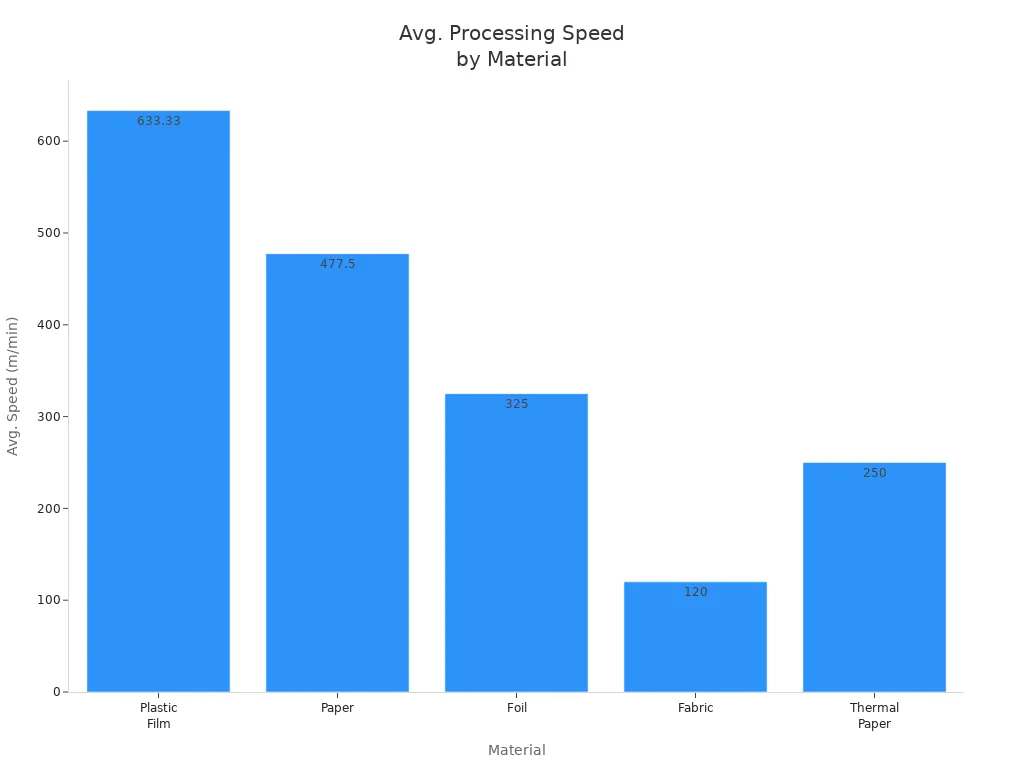
Plastic film is the most common material for slitter rewinders. Some machines can go up to 1,200 meters per minute. Paper machines also run fast. Foil slitters work with thin materials at about 150 meters per minute. Fabric slitters are slower, around 120 meters per minute. These speeds help factories pick the right machine for each job.
Workers need training to use the slitter rewinder safely. Training teaches them about the machine and how to use it. They learn safety rules and how to wear protective gear. They check the machine before using it. They follow steps to use the machine the right way. They learn to change settings, handle materials, and fix problems. The table below lists important training topics:
Training Aspect | Key Training Content |
|---|---|
Safety and Regulatory Compliance | Training on machine safety features, emergency stops, guards, lockout/tagout, PPE use, and industry standards (OSHA, ANSI). |
Machine Operation and Maintenance | Understanding machine components, controls (HMI, PLC), and basic maintenance like cleaning and troubleshooting. |
Material Handling and Setup | Proper handling of aluminum coils, setup on unwind stand, tensioning, alignment, and operating parameters. |
Slitting Parameters and Quality Control | Adjusting blade spacing, feed rate, monitoring slitting accuracy, and ensuring product quality. |
Process Optimization and Troubleshooting | Identifying issues like burrs or chatter, minimizing waste, and improving productivity through parameter adjustments. |
Workers must follow these steps to stay safe and work well:
Get trained and earn a qualification.
Wear safety gear like helmets and gloves.
Check the machine before starting.
Follow the rules and do not change settings without permission.
Use safety devices like emergency stops.
Handle materials carefully to avoid accidents.
Stop the machine before changing tools.
Stop and report problems right away.
Clean and check the machine after using it.
The slitter rewinder machine helps companies make good rolls with little waste. Its smart features and flexible styles make it important in factories. Trained workers can use the machine safely and keep products high quality.
The slitting and rewinding process changes big rolls into smaller ones. This process uses a slitter and a rewinder. It works with paper, plastic film, and foil. There are three main steps: unwinding, cutting, and rewinding. Each step helps make sure the final rolls are good quality.
Unwinding is the first step. Workers put a big master roll on the machine. The rewinder uses tension control to move the material smoothly. Tension control stops the material from stretching or wrinkling. Many new machines use sensors and automatic systems. These keep the tension steady. This helps stop problems and keeps the material flat.
Tip: Good tension control during unwinding keeps the material smooth and helps the slitting and rewinding process go well.
Operators set the speed and tension for each material. Thin plastic film needs gentle tension. Thick paper can handle more force. The machine checks these settings and changes them if needed. This step gets the material ready for cutting.
After unwinding, the material goes to the cutting part. The slitter uses different blades to cut the material into strips. The blade type depends on the material and strip width. The three main slitting methods are razor slitting, shear slitting, and score slitting.
Slitting Method | Cutting Principle | Best Suited For | Efficiency | Precision | Advantages | Limitations |
|---|---|---|---|---|---|---|
Razor Slitting | Fixed blade cuts as web passes | Thin films, light foils, delicate materials | Quick setup, up to 300 m/min | High for thin materials | Cost-effective, clean cuts | Blade wear, heat buildup, limited to thin materials |
Shear Slitting | Scissor action between two rotary knives | Wide range, including thick and coated materials | High speed, flexible | Highest, clean edges | Versatile, precise cuts | Setup complexity, maintenance |
Score (Crush) Slitting | Blade compresses web against an anvil | Thick, adhesive, compressible materials | Moderate speed | Less precise | Handles tough, sticky materials | Rough edges, dust, not for high precision |
Shear slitting uses two round knives that work like scissors. This method gives the cleanest edges and works for many materials. Razor slitting uses a fixed blade and is best for thin films and foils. Score slitting presses the material on an anvil and is good for thick or sticky materials.
The machine lines up the blades for the right strip widths. Operators can move the blades using digital controls. Some machines have automatic knife positioning. This saves time and makes cutting more accurate. The process needs careful cutting to stop waste and make sure each roll is the right size.
Problems during cutting can be bad edges, bent strips, or strips that are not the same size. Operators fix these by checking blade sharpness and knife space. They also use tension control systems. Regular care and checks help the machine work well.
After cutting, the strips go to the rewinder. The rewinder rolls each strip onto a new core. Tension control is still important here. The machine uses sensors and feedback to keep the rolls tight and even. If tension is too loose, rolls can become uneven. If tension is too tight, the material can stretch or break.
A normal rewinder, like the JT-SUR-1300, can go up to 400 meters per minute. Operators set the speed based on the material and roll size. The machine guides each strip to keep them straight. Some machines use special winding for tricky materials.
After rewinding, the machine checks the finished rolls. Special systems look for defects and check size and quality. Operators may use counters and sensors to track roll length and diameter. If there is a problem, the machine tells the operator.
Note: Checking quality during slitting and rewinding helps keep products good and lowers waste.
Common problems during rewinding are loose rolls, wrinkles, and uneven rolls. Operators fix these by changing tension, checking sensors, and making sure strips are lined up. Automatic systems help reduce manual work and make rolls more even.
Put the master roll on the machine and set speed and tension.
Move the material through the slitter, where blades cut it into strips.
Guide and line up the strips on the cutting table.
Roll each strip onto a new core, keeping tension even.
Check the finished rolls for defects and correct size.
The slitting and rewinding process lets factories make rolls in custom sizes. Careful unwinding, cutting, and rewinding give high-quality results. Modern machines use automation and smart controls to make the process faster and better. This helps companies waste less, save money, and make better products.
A slitting machine has many important parts. These parts help turn big rolls into smaller ones. Each part does a special job in the process. The main parts are the unwinder, slitting section, rewinder, and controls. All these parts work together. This helps the machine work well and keeps it safe.
Component | Function |
|---|---|
Unwinder | Holds and feeds the master roll into the slitting machine. |
Slitting Section | Uses sharp blades or rotary knives to cut the material into narrow strips. |
Rewinder | Rolls the cut strips onto new cores, creating smaller finished rolls. |
Controls | Manages speed, tension, blade position, and safety features for the whole process. |
The unwinder holds the big roll at the start. It feeds the material into the machine at a steady speed. Many new unwinders use automatic tension control. This keeps the material flat and stops wrinkles. Some unwinders have sensors to change speed and tension. This helps the machine run smoothly and makes less waste.
The slitting section is where the machine cuts the material. It uses different blades like rotary knives or razor blades. Operators can move the blades for different strip sizes. Some machines have digital blade settings and automatic knife changes. These features make setup faster and cutting more accurate. The slitting section may also use rubber rings to guide the strips. This part is very important for making clean cuts.
The rewinder takes the strips after they are cut. It rolls each strip onto a new core. Some rewinders use separate motors and sensors for tension and speed. This keeps the finished rolls tight and even. Some models have automatic core loading and quick change systems. These features help save time and keep work going. The rewinder makes sure each roll is the right size and quality.
The control system is like the brain of the machine. It uses special computers and screens to manage everything. Operators can set blade speed, tension, and strip width on a touch screen. Modern controls can watch the machine in real time and check for problems. Sensors and cameras look for defects and measure roll thickness. Automation helps stop mistakes and keeps workers safe. Safety features like emergency stops protect people during work.
Operators use the control system to keep the machine safe and working well. Automated controls help make good products and stop delays.
Slitter machines are important in many industries. They help companies cut big rolls into smaller pieces. The converting industry uses them for printing, coating, and laminating. Workers use slitter machines with polyester, silicone, tape adhesives, foams, plastics, felt, rubber, liners, and sheet metal. In the marine and fishing industries, slitter machines cut rubber, foams, fabrics, and films for boats and fishing gear. Electronics companies use them to get films and plastics ready for devices.
Construction companies use slitter machines for rubber, foams, and fabrics in building work. Custom packaging companies need slitter machines to make flexible packaging. The apparel and recreation industries use them to cut fabric for clothes and sports gear. Retail stores use slitter machines to get packaging and display materials in the right size.
The table below shows how different industries use slitter machines for different materials:
Industry | Materials Processed with Slitter Machines |
|---|---|
Aerospace | Aluminum for aircraft wings and fuselage parts |
Automotive | Sheet metal, especially aluminum, for car parts |
Metal Roofing | Steel and aluminum sheets for roofing panels |
Converting | Polyester, silicone, tape adhesives, foams, plastics, felt, rubber, liners, sheet metal |
Marine | Rubber, foams, fabrics, films, plastics |
Electronics | Films and plastics for electronic devices |
Construction | Rubber, foams, fabrics, films, plastics |
Custom Packaging | Flexible packaging materials |
Apparel & Recreation | Fabrics and related materials |
Retail | Packaging and display materials |
Slitter machines help these industries work faster and waste less. They make sure materials are the right size for each job.
Slitter machines make many products people use every day. They cut thin rolled materials like paper, vinyl, films, foils, polymers, and building materials. Companies use slitter machines to make coreless POS rolls and POS receipt rolls for stores and banks. Lottery tickets and airline boarding passes are also made with slitter machines. Photo papers and dye sublimation paper for printers need careful cutting.
Pressure-sensitive vinyl and graphic vinyl rolls are used for signs and graphics. Label stock and linerless receipt rolls help with packaging and sales. Plotter and kraft rolls are used by engineers and artists. Void fill materials protect things during shipping. Paint masking materials help painters cover surfaces. Housewrap and roofing underlayment keep buildings safe from weather. Landscaping materials help in gardens and outdoor spaces.
Slitter machines have many uses in different industries. They help companies turn big rolls into smaller, useful products. This saves time and money and helps meet the needs of many markets.
Many products made with slitter machines end up in homes, stores, and workplaces. These machines help make things people use for shopping, travel, printing, building, and more.
Slitter machines help factories finish jobs faster. These machines can cut big rolls into small ones quickly. Workers do not have to watch every step. The machine uses smart controls to keep things steady. This means there are fewer mistakes. The work keeps moving without stopping. Manual cutting is slower and needs more people. It also causes more errors. Automated slitter machines have features like automatic tension control and knife setup. These features help the machine run without stopping.
Automated slitter machines let workers check quality instead of doing hard work, so the process is more efficient.
Feature/Aspect | Slitter Machines (Automated & Manual) | Traditional/Manual Cutting Methods |
|---|---|---|
Precision and Accuracy | High precision with rotary blades or laser technology; uniform cuts reduce waste and defects | Less precise; manual adjustments lead to inconsistencies and higher material waste |
Speed and Efficiency | High-speed cutting of large rolls; automation reduces supervision and increases throughput | Slower cutting speeds; more setup time; labor-intensive and less efficient for large volumes |
Labor Intensity | Reduced labor due to automation; operators supervise rather than perform manual tasks | Labor-intensive; requires constant manual operation and oversight |
Factories save money when they use slitter machines. These machines cut materials very accurately, so there is less waste. Less waste means factories spend less on materials. Automation also means fewer workers are needed. This helps companies save on paying workers. Over time, saving on waste and mistakes adds up. Slitter machines cost more at first, but they save money later by working faster and better.
Manufacturers often get their money back from these machines. They figure out how long it takes to pay off the machine by dividing the cost by the yearly savings. A strong and good machine can pay for itself faster. Companies should think about saving money in the long run, not just the first price.
Slitter machines help businesses with small budgets by cutting waste and making more products.
Slitter machines help make products that are always the same. Automated controls make sure each cut is the right size and shape. This is important for products that need to be exact. When factories use slitter machines, they see fewer mistakes and better results. Newer machines can do different jobs and still keep quality high. Automation also stops mistakes that people might make.
Slitter machines make cuts that are always the same and meet strict rules.
Every cut is the right size, so finished products match.
Automated systems look for problems and let workers fix them fast.
Computer controls keep blades in the right place and stop cutting mistakes.
Keeping the machine clean and checked helps it work well.
Many factories use slitter machines to pass quality tests and meet industry rules. These machines help companies make better products with less waste.
Slitter Rewinder Machines are important in factories. They cut big rolls into smaller pieces quickly and accurately. New machines use special blades and smart controls. This helps them work faster and waste less material. Upgrading these machines can make them run even faster. It also helps save energy and money.
Slitter Rewinder Machines help companies spend less and make better products. They help meet quality rules and make things people use every day. These machines are used in packaging, textiles, and electronics. They help factories work smarter and save money.
A Slitter Rewinder Machine takes big rolls and cuts them smaller. It puts each strip onto a new core. This helps companies get rolls in the right size. These rolls are used for packaging, printing, and more.
Factories use Slitter Rewinder Machines for many materials. They work with paper, plastic film, aluminum foil, fabric, tape, rubber, and nonwoven materials. Operators change the settings for each type. This makes sure the cuts are clean and the rolls look good.
Slitter Rewinder Machines are fast and very accurate. They use automatic controls to stop mistakes. This helps workers do less manual work. Factories save time and money because the machine works quickly.
Operators need training before using a Slitter Rewinder Machine. They must wear safety gear and check the machine often. Emergency stops and sensors help keep workers safe. Modern machines have extra safety features.
Industries pick Slitter Rewinder Machines to waste less and save money. These machines make rolls that are always the same and high quality. They are used for packaging, printing, electronics, and textiles.